
News Article
 October 14th, 2026 by Andy Samuel
Carlos Alcaraz Wants More Time Away From Tennis. What Should Coaches Learn From That?
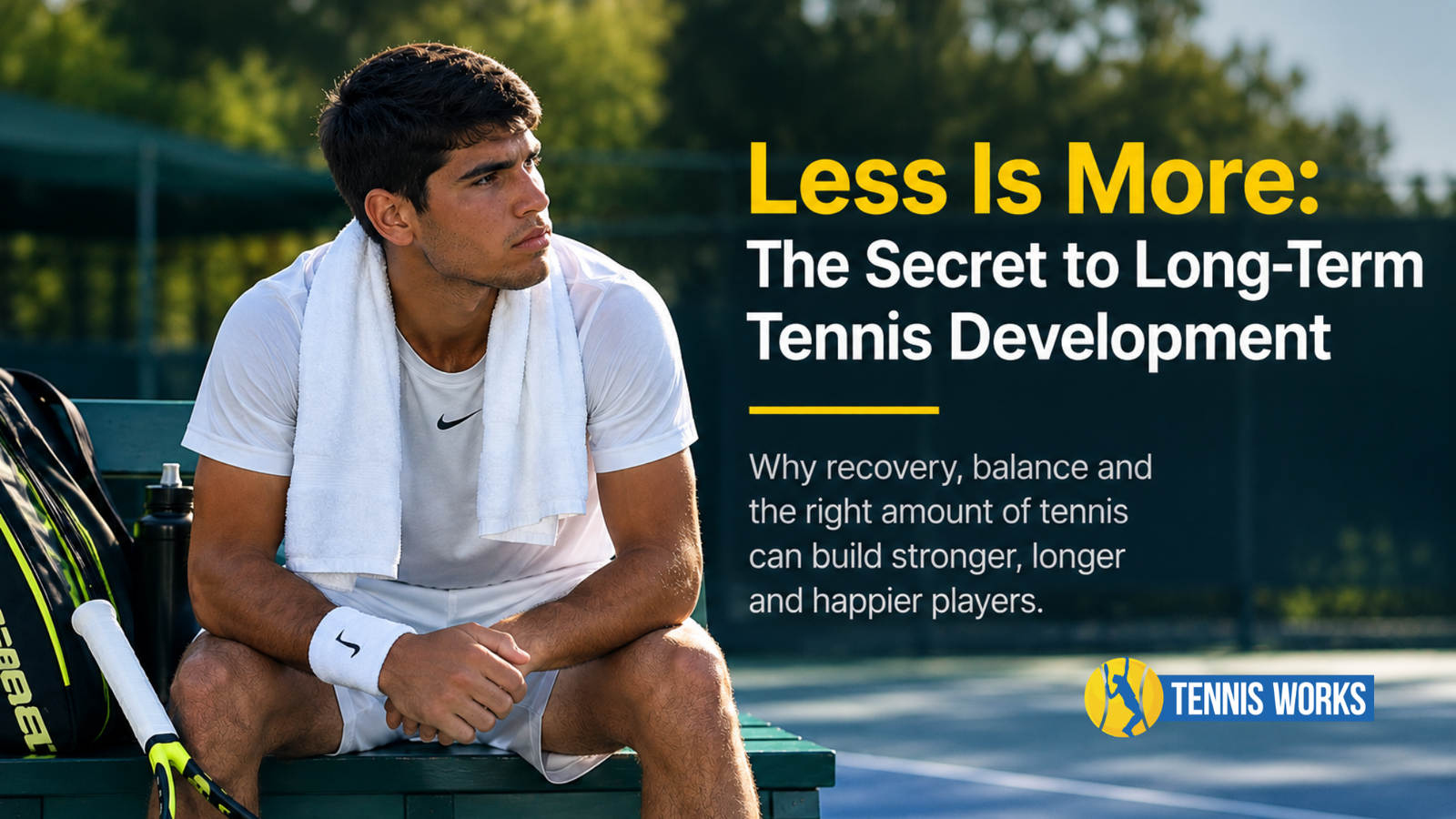
One of the most interesting conversations coming out of the US Open this year isn’t just about who will lift the trophy. It’s about how much tennis our best players are expected to play. Carlos Alcaraz has spoken openly about the demands of the modern tennis calendar and said he intends to take longer breaks in the future. He has suggested that periods away from competition may be necessary to protect his body and extend his career.
As a coach, I think we should pay very close attention. Because this isn’t simply a professional tennis issue. It is a player-development issue.
More Tennis Doesn’t Always Mean More Development
One of the biggest misconceptions in junior tennis is that more is automatically better.
– More lessons.
– More tournaments.
– More fitness.
– More hitting.
– More competition.
– More rankings.
But development doesn’t work quite that simply.
A player needs stimulus, but they also need recovery.
They need competition, but they also need training.
They need challenge, but they also need time to consolidate what they’ve learned. And sometimes the most productive thing a player can do is not play tennis.
The Modern Player Is Under Pressure Earlier
Junior tennis has become increasingly competitive. Players are exposed to rankings, results, social media and performance comparisons from a very young age. It can become incredibly easy for a player and sometimes their parents or coaches to feel that every week needs to produce progress. But development isn’t linear. I’ve worked with enough players over the years to know that some of the biggest improvements happen when we step back. A player may spend months working on something without seeing obvious results. Then suddenly, after giving the player time to absorb the work, everything starts to come together. That isn’t wasted time. That’s development.
We Need To Coach The Whole Athlete
This is one of the reasons I believe coaching has to extend beyond technical instruction. If I’m responsible for a player’s development, I’m not only thinking about their forehand. I’m thinking about their physical development, emotional development, competitive schedule, motivation, confidence and long-term relationship with the sport. The question shouldn’t simply be: “How much tennis can this player do?”
It should be: “How much tennis can this player absorb effectively?”
There is a huge difference.
What Can Clubs And Coaches Do?
I think every serious coaching programme should periodically review a player’s workload.
Look at:
- Training volume
- Competition schedule
- Travel
- Physical conditioning
- Recovery
- School or education
- Motivation
- Sleep
- Stress levels
- Enjoyment
And perhaps most importantly, talk to the player. We sometimes spend so much time telling young players what they should do that we forget to ask them how they are actually feeling. That conversation can tell you a great deal.
The Goal Is A Career Not A Season
Carlos Alcaraz is already one of the biggest names in world tennis, yet even he is recognising the importance of managing his schedule carefully. His comments come at a time when the professional calendar has become increasingly demanding and several leading players have dealt with injuries. For coaches working with younger players, the lesson is even more important. We’re not trying to create a brilliant 12-year-old. We’re trying to help create a player who still loves tennis at 22, 32 and beyond. That requires patience. It requires planning. And sometimes, it requires knowing when less is more. That’s not lowering our standards. That’s coaching for the long term.
Happy tennising.